
The Rules-Based International Order is Eroding, Indonesia Must Accelerate its Reindustrialization

The Berlin Wall. Source: Wikimedia Commons
It was in 1992 that Francis Fukuyama published The End of History and the Last Man, written in the aftermath of the Soviet Union’s dissolution and the apparent consolidation of liberal democracy as the world’s default political-economic model. At the time, the popular narrative (in actuality a misinterpretation of Fukuyama’s thesis) seemed straightforward: neoliberal capitalism and liberal institutions had “won,” and the rules-based international order–guaranteed by the world’s sole hegemon–would act as both referee and stabilizer.
Fast forward 34 years, and that premise now looks naive. We are no closer to utopia and witnessing the end of history. The recent Iran-Israel-US conflict is perhaps most indicative of this reality. International law and the maintenance of the liberal order seem to be of secondary concern to self-interested states seeking to upend the balance of power and achieve hegemonic dominance through brute force. In geopolitical terms, the world of 2026 is perhaps more similar to the world of 1936 than the world of 1996. The unipolar stability of the post-Cold War order is fading away, and we are regressing further toward great power politics, toward a more fragmented, more multipolar world where diplomatic coercion, tariffs, and blatant military interventions are routine instruments of statecraft. In other words, rather than the end of history, we are witnessing the return of it—with a vengeance.
This shift has also been articulated very bluntly by the figures at the commanding heights of the global order. In a highly-lauded address in Davos in January, Canada’s Prime Minister Mark Carney spoke of the fading “rules-based” order and argued that, in important respects, the order has always been illusory. It was an arrangement that did not always reliably deliver shared gains and could be and has been weaponized by existing and would-be hegemons. In that same speech, he also argued: middle powers can no longer assume that global rules will always protect them and that they must build protection into their own capabilities. Mark Carney was indirectly speaking about Indonesia–Indonesia, clearly, is a middle power.
For a middle power such as Indonesia, this diagnosis demands urgency and attention. Preparedness in the present international context is not reducible to military capacity alone; it rests fundamentally on hard economic power. More specifically, autonomy in the international order is grounded in the productive capabilities of the national economy: the ability to produce, innovate, and sustain technological upgrading across strategic sectors. This insight is not new. In his Report on the Subject of Manufactures (1791), Alexander Hamilton argued that “not only the wealth, but the independence and security of a Country, appear to be materially connected with the prosperity of manufactures.”
And in our current multipolar system, that claim has acquired a renewed force. States that lack economic strength are more vulnerable to external coercion, more exposed to supply disruptions, and less able to defend domestic policy space under conditions of geopolitical competition. By contrast, economic power enlarges strategic choice: it enables states to finance development on their own terms, mitigate dependence on weaponizable interdependence, sustain military capabilities over time, and bargain externally from a position of greater resilience. Military power itself, in this sense, is derivative of an underlying economic base. Where industrial depth and technological capability are weak, strategic autonomy remains limited and fragile.
For certain powers, such leverage may be used aggressively. Indonesia’s interest is of a different character: defensive rather than offensive. The object is not to dictate, but to avoid being dictated to; not to coerce, but to insure. A larger, more capable industrial base—able to produce the strategic goods of modern life and export tradables at scale—expands the country’s feasible policy set in a world of colliding interests and asymmetric power. It materially raises the outside option such that when the terms are unfavorable, one can afford to credibly decline them rather than accept without question.
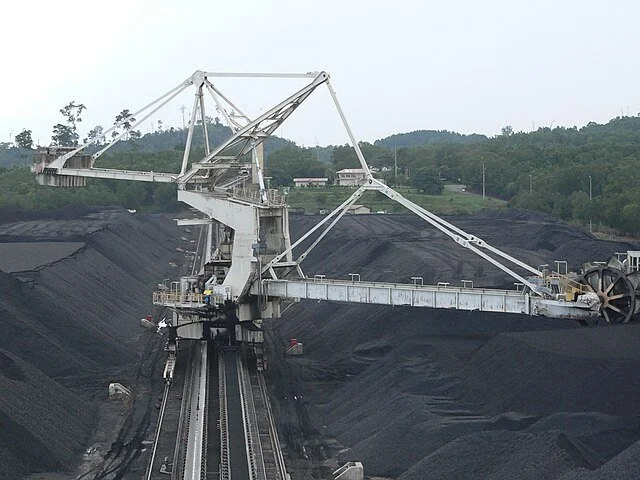
Coal mining in East Kalimantan. Source: Wikimedia Commons
Unfortunately, the post–Cold War order also coincided with a steady erosion of Indonesia’s industrial base. Indonesia became a spectator to other countries’ industrial deepening, supplying the minerals and agricultural inputs that powered their factories while Indonesia’s own productive base thinned. For a time, the bargain looked tolerable: commodity booms in the 2000s and the early 2010s delivered windfalls and softened the urgency of structural transformation. But when the cycle flipped, the asymmetry in industrial development became very much obvious. Indonesia, had, in effect, been deindustrializing in a way that subsidized others’ industrialization: exporting the raw materials, importing the higher value-added, and accepting the economic volatility and political vulnerability that come with a narrow, commodity-led growth model.
Indonesia therefore needs to urgently discard its old growth model and treat rapid reindustrialization as a primary objective of government policy, both in statement and in action. The case, clearly, is geopolitical and developmental at the same time. Industrialization is synonymous with sovereignty and growth. But this is also exactly where Indonesia’s current development narrative becomes dangerously incomplete. Downstreaming natural resources—while important and worth pursuing—will not be sufficient. It can raise value added and improve the trade balance at the margin, but it does not automatically generate frontier capabilities. Tomorrow’s economy will be powered by advanced manufacturing ecosystems: semiconductors, solar PV and battery storage, industrial automation, precision machinery, and electric vehicles. These sectors are not defined by access to ores. They are defined by learning curves, process know-how, engineering density, and the ability to coordinate complex supply chains.
Taiwan did not become indispensable to the global economy because it had a privileged endowment of raw materials. It became indispensable because it built a high-technology production system in semiconductors that other countries could not easily replace. It did not need the world’s largest reserves of sand to build chips. Indonesia’s strategic problem is that its rich endowment of resources often seduces policymakers into thinking that control over natural resources alone equals economic power. It never does. Resource ownership can be a rung on the ladder, but it is not the ladder.
Furthermore, if Indonesia is serious about reindustrializing, it must move beyond the standard Washington Consensus narrative that industrialization is mainly a matter of “improving the business climate.” Cutting red tape and lowering logistics costs may raise output at the margins, but they do not constitute an industrialization strategy. Rapid industrialization is not what happens when the state merely gets out of the way. As the East Asian miracle countries have shown: it happens when the state coordinates with the private sector to solve the central problem of structural transformation: the coordination and deployment of resources across multiple sectors at once. The real binding constraint is therefore not permits or logistics, but the ability to align various policies and sectors: finance, skills, infrastructure, trade policy, and technology acquisition behind a limited set of strategic missions focused on broad-based reindustrialization. That is why the term used in the economics literature is exactly right: industrialization requires a big push—a front-loaded, economy-wide surge of coordinated investment, public and private, large enough to overcome coordination failures, internalize complementarities, and shift the economy onto a higher-productivity path.

Indonesia’s N250 aircraft prototype. Source: Wikimedia Commons
Enabling a big push thus requires industrial policy, active public-private coordination to alter an economy’s productive structure. Indonesia’s historical experience with industrial policy was mixed, and in some periods outright disappointing. But the external environment has changed. In a world where major economies openly subsidize strategic sectors, impose tariffs, control technology, and reshore supply chains, treating industrial policy as “optional” is rarely a best response—to borrow a term from game theory. For many middle powers, a purely hands-off stance becomes an inferior strategy once other, more dominant powers, actively shape markets through policy. To quote Dani Rodrik, an economist at the Harvard Kennedy School: the relevant question is therefore not whether we should do industrial policy, but whether we can do it well: learning from past mistakes, borrowing design features from more successful cases, and building policies that reward innovation and competitiveness rather than rent-seeking and protected inefficiency.
The central challenge will be coordination failure. Private firms will not invest at scale in complex high-technology products if complementary inputs—skills, infrastructure, finance, and technology access—are inadequately provisioned. Solving that requires an institutional mechanism that can synchronize investments across sectors and time. This is where Danantara could matter. Recent efforts to mobilize financing are a start, but the portfolio still appears insufficiently mission-driven. If Danantara is to contribute meaningfully to a big push, it needs a sharper focus: capability-building industrialization should be treated as a primary allocation priority, with clear sector missions, measurable milestones, and governance that ties capital deployment to clear developmental outcomes. And like Japan’s famous Ministry of International Trade and Industry (MITI), it needs to be insulated from short-term political pressures to be able to make long-term developmental decisions.
Ultimately, this is a question of strategic realism and sovereignty. Indonesia is entering an era in which economic power will determine bargaining power, resilience, and autonomy. A big push is a hedge against vulnerability in a harsher international system. The task is straightforward, even if the execution is not. One needs to pick a small number of missions, coordinate the instruments required to deliver them, and hold institutions accountable for capability, to be measured in jobs that are created, patents that are registered, and machines that are deployed, rather than in speeches, slogans, or deal volume.
The only alternative is vulnerability. It is vulnerability to commodity price shocks, to becoming passive actors in other countries’ trade wars, to losing strategic autonomy bit by bit in a world increasingly governed less by rules but by strength. After all, to slightly rephrase Thucydides, we must do what we can, so that we do not suffer what we must.