Message from Bonn: The Fight Over Climate Finance is Also a Fight Over Green Industrialization
Written by Bambang Trihadmojo, Sustainability Lead at Industrial Policy Lab Indonesia
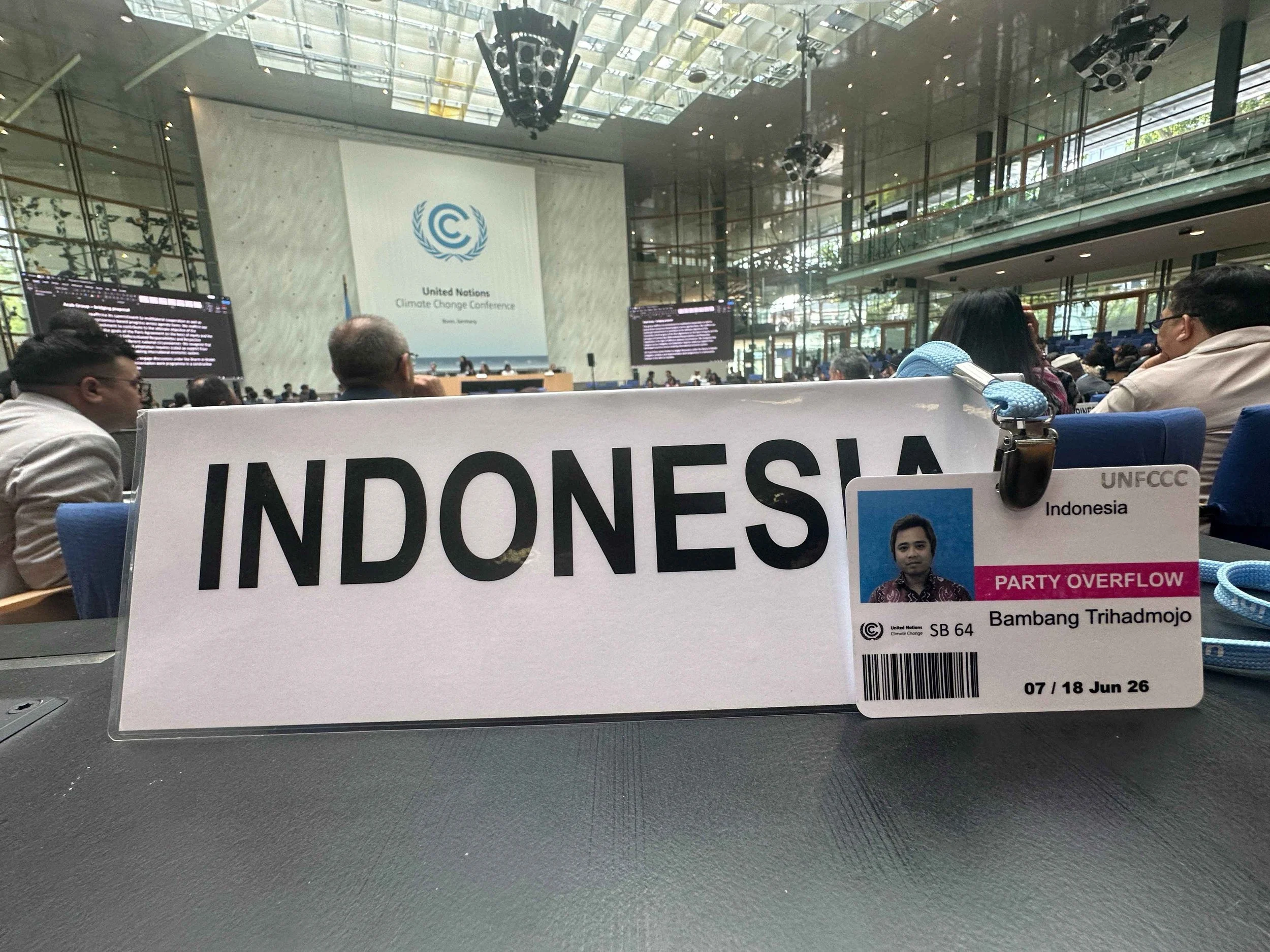
Earlier this month, I spent two weeks in Bonn attending back-to-back climate finance meetings. The first was the 64th Sessions of the Subsidiary Bodies of the UNFCCC (SB64) that took place from June 8 to 18. The second was the 40th meeting of the UNFCCC Standing Committee on Finance (SCF40), on June 19 and 20. I left with one conviction. The struggle over climate finance is also a struggle over whether developing countries will have the policy space and financial resources to pursue green industrialization on their own terms.
At SB64, I followed three negotiation tracks: the Climate Finance Work Programme under Article 9.1, the Veredas Dialogue on Article 2.1(c), and the Adaptation Fund negotiations. At SCF40, I observed the committee's work on assessing and defining climate finance. These forums gave a clear view of where the global finance debate now stands.
Public climate finance is shrinking. Developing country negotiators laid out the figures plainly. They pointed out that Global Environment Facility's latest replenishment came in at $3.9 billion, nearly 27 percent below the previous round and its lowest in sixteen years. They also said that Green Climate Fund absorbed about $1.1 billion in cuts after a developed country withdrew close to $4 billion in pledges. Meanwhile, the Adaptation Fund spent 2025 running at roughly a third of its target. These figures suggest that the supply of public, concessional, grant-based finance is contracting at the very moment developing countries are being asked to mobilize capital at industrial scale for climate action and development.
The clearest battles emerged in two spaces, the new Climate Finance Work Programme and the consultations on the Adaptation Fund. The Work Programme, a two-year process launched at COP30 in Belém, Brazil, became a fight over scope and core purpose. Developing countries argued that it should be firmly grounded in Article 9.1 of the Paris Agreement, which sets out the obligation of developed countries to provide climate finance. From their perspective, the programme should track whether those commitments are being met and strengthen accountability for past pledges.
In contrast, developed countries pushed for a broader interpretation covering all of Article 9, linking it to Article 2.1(c), which calls for making financial flows consistent with low-emission development, and to the new global finance goal agreed in Baku, Azerbaijan. The emphasis here was less on public finance obligations and more on reducing investment risk and mobilizing private capital at scale. By the end of the session, there was still no shared understanding of what the Work Programme was primarily meant to do.
A similar strain was visible in the Adaptation Fund consultations. The fund is transitioning from the Kyoto Protocol to the Paris Agreement and raised governance questions Parties could not resolve. They carried those questions forward to COP31 in Antalya, Türkiye, with the fund still operating far below its target.
In another room, the Veredas Dialogue convened for the first time and gave a sense of where the debate is likely to move next. Built around Article 2.1(c), it took on an agenda that goes far beyond dedicated climate funds. The dialogue reaches into public budgets, financial regulation, and private investment across the wider economy.
Developing countries acknowledged the importance of this broader frame but set firm boundaries. They argued that aligning financial flows should support the obligation of developed countries to provide finance rather than replace it. The developing country negotiating blocs also warned against new conditions or reporting requirements that could shift the burden onto them. Few disputed that the transition is too large for public finance alone. Still, many worried that aligning all financial flows could slowly obscure the question of responsibility, until it is no longer clear who must provide finance and under what obligation.
Away from the negotiating rooms, similar questions surfaced at SCF40. The committee's work on assessing and defining climate finance is technical in appearance but politically significant in practice. A large part of the discussion focused on what should count as climate finance. This is not a neutral question. A grant transfers resources outright, while a market-rate loan must be repaid with interest. If both are treated equally, pledges can appear fully delivered even when the actual support is far lower. How these definitions are set determines how success and failure are measured against the new finance goal of $300 billion a year in provision and $1.3 trillion from all sources.
A single shift runs through all four meetings. The debate is no longer primarily about how much climate finance is pledged. It is about what counts, who is obligated to provide it, and who bears the risk when it falls short.
For developing countries pursuing green industrialization, this shift is consequential. It will shape whether they can build domestic clean industries on their own terms or remain locked into roles defined by exporting raw materials within global value chains that others control.
Green industrialization is increasingly the most viable path to development and growth. The era of cheap fossil-fuel-led industrialization is narrowing as export markets begin pricing carbon through mechanisms such as the EU’s Carbon Border Adjustment Mechanism and as capital moves away from high-emission projects. At the same time, developing countries bear a disproportionate share of the physical and economic costs of climate change, which makes fossil-based industrialization a wager against their own long-term interests. In this context, green industrialization is not simply a response to external pressure; it is the form of industrialization most likely to remain competitive, resilient, and financeable in the decades ahead.
The question of who finances this transition is separate, and history offers a clear answer. Major industrial transformations have rarely been driven by private capital alone. South Korea used state-directed credit to build globally competitive steel and shipbuilding industries, while China’s solar manufacturing sector expanded through sustained public banking support long before private investors entered at scale. Today, the European Union follow a similar model through extensive subsidies and public support for clean technology manufacturing. These cases demonstrate that the state absorbs the early risks that private markets are unwilling to take and thereby creates the conditions for new industries to emerge and grow.
Ironically, countries that are now champions of open markets frequently relied on strong state support during their own industrial catch-up phases. Preaching open markets to the developing world is an outright hypocrisy, to say the least. To deny developing countries the same support is to kick away the ladder.
Indeed, my conviction is that the state must lead green industrialization. Conventional wisdom agrees that new industries cannot survive their infancy in an open contest with established foreign rivals. A solar or battery manufacturer in a developing country typically starts far behind established global competitors that already benefit from scale, cheaper capital, and accumulated technological know-how. Without a period of protection and public backing, it is unlikely to reach the point where it can compete at all.
There is also a structural reason markets alone struggle in this context. Green industrialization requires long-horizon investment in production capacity, infrastructure, skills, and supply chains that no single private actor is willing or able to coordinate at scale. Private capital tends to wait until these conditions are already in place. This is why early-stage industrial development has historically depended on the state taking on risk and coordinating investment. It is a defining feature rather than an exception to development.
While the state may need to lead green industrialization, developing countries cannot finance it the way wealthier ones can. High-income governments draw on large domestic budgets and borrow at relatively low interest rates. Meanwhile, many developing countries face higher debt burdens, more expensive borrowing costs, and limited fiscal space. This is precisely the gap that international public climate finance is meant to address. When that finance declines, or when it arrives primarily as loans rather than grants, the gap grows. Countries are then expected to finance structural transformation through debt and effectively paying for industries that wealthier states built with subsidies and protection. The expectation that the state should lead remains. The resources to do so do not.
Beyond questions of responsibility or fairness, there is a climate logic at play. Most future growth in emissions is expected to come from developing and emerging economies since that is where industrial expansion, urbanization, and rising energy demand are concentrated. If these countries lock in fossil-based infrastructure as they industrialize, global emissions will continue to rise even as wealthier countries decarbonize. A transition that proceeds on two separate tracks is not a real transition. It would simply slow the trajectory toward the same outcome. Therefore, financing green industrialization in developing countries is not a secondary benefit of climate policy. It is central to whether the global transition succeeds at all.
Some of this tension may come into sharper focus at COP31 in Antalya, Türkiye. In their joint presidency letter, Türkiye and Australia identified green industrial transformation as a central priority and pledged to advance Article 9 and Article 2.1(c) in tandem. The key question for the next round of negotiations is whether that balance can be maintained in practice or whether public finance obligations will gradually be subsumed within broader commitments to align all financial flows with climate objectives.