
Event Recap
On 14 October 2026, Industrial Policy Lab Indonesia (IPL), together with Broaden Economics (Vietnam) and the Institute for Democracy and Economic Affairs (IDEAS, Malaysia), held a roundtable in Bangkok titled Building an ASEAN Regional Framework for Green Industrial Policy Coordination. The session brought together researchers and knowledge partners from across the region, both in the room and online, to discuss the interim findings of our joint study.
Over two and a half hours, the consortium presented what we have found so far on ASEAN's position in the solar PV and electric vehicle (EV) supply chains, how each government is supporting these industries, and what the current ASEAN framework can and cannot do. The second half was an open discussion on what kind of coordination the region actually needs.
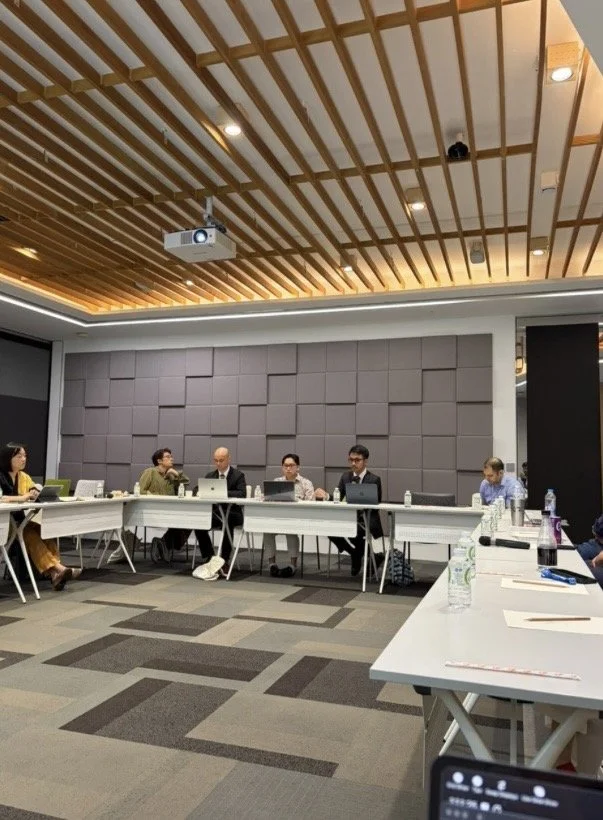

The consortium presenting interim findings at the Bangkok roundtable, 14 October 2026.
What we are studying
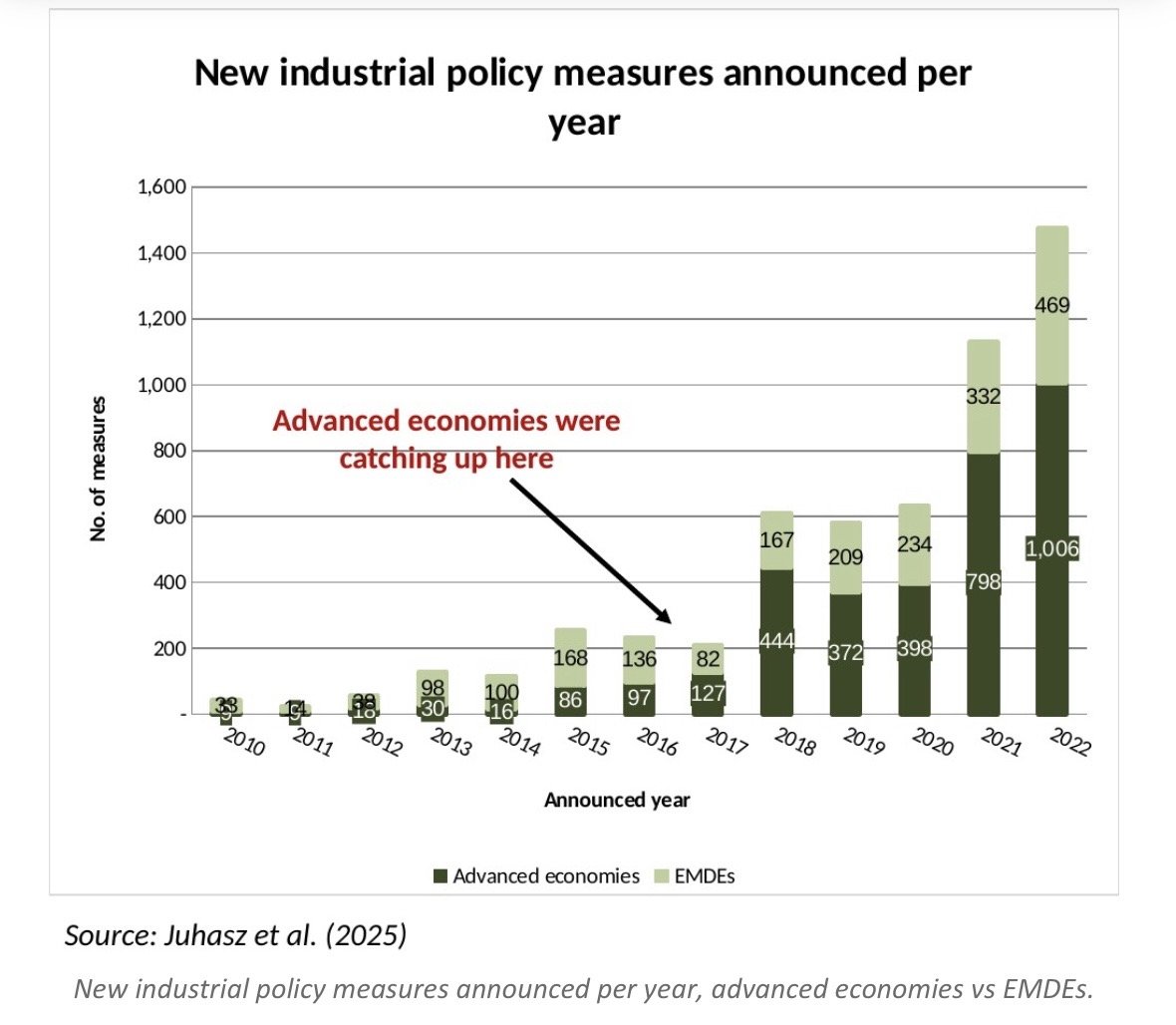
The study starts from a simple observation: industrial policy is back. New industrial policy measures announced worldwide rose from around 40 in 2010 to nearly 1,500 in 2022, and since 2017 advanced economies have announced roughly two-thirds of them. Developing economies enter this race with less fiscal space, higher borrowing costs, and fewer tools, since local content requirements, export bans and tariff increases are now constrained by WTO and free trade agreement rules.
For ASEAN, there is an added risk. When member states pursue near-identical green industrial strategies, they end up competing for the same investors, and multinationals can shop for incentives across governments. Other regions have started to respond with regional frameworks, from the EU's Clean Industrial Deal to Africa's Green Minerals Strategy. ASEAN does not have one yet. Our study asks what such a framework could look like, focusing on two supply chains: solar PV and EVs, including batteries.
The work has three parts.
1. Where ASEAN stands in the supply chain
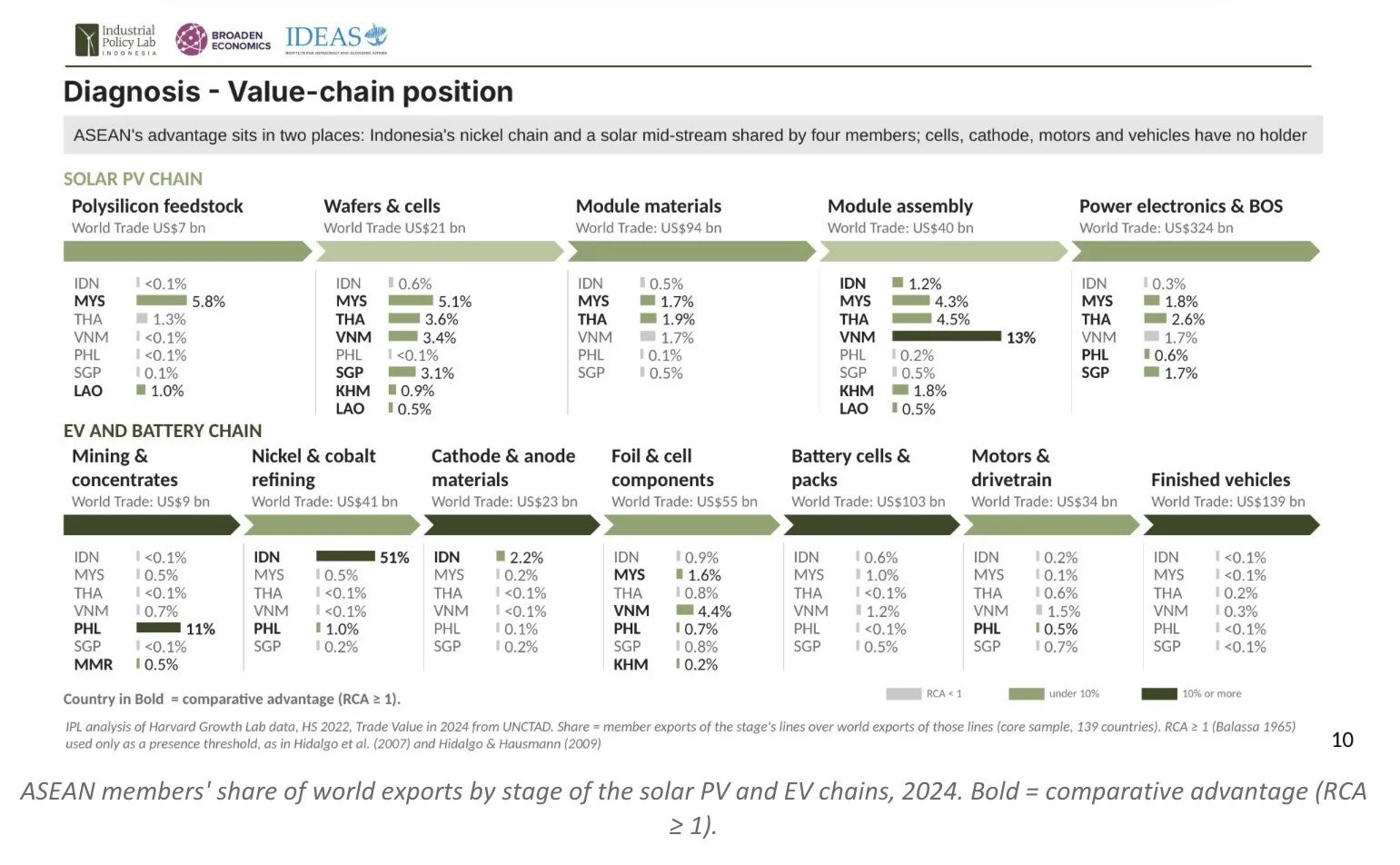
Using 2024 trade data, we split both chains into twelve stages, from mining to finished vehicles, and measured where each member has a comparative advantage. ASEAN's strength is concentrated in two places: Indonesia's nickel chain, where it holds about 51 percent of world exports of refined nickel and cobalt, and a solar mid-stream shared by several members, with Vietnam alone accounting for 13 percent of world module exports. Further down the EV chain, in battery cells, motors and finished vehicles, no member has an advantage yet.
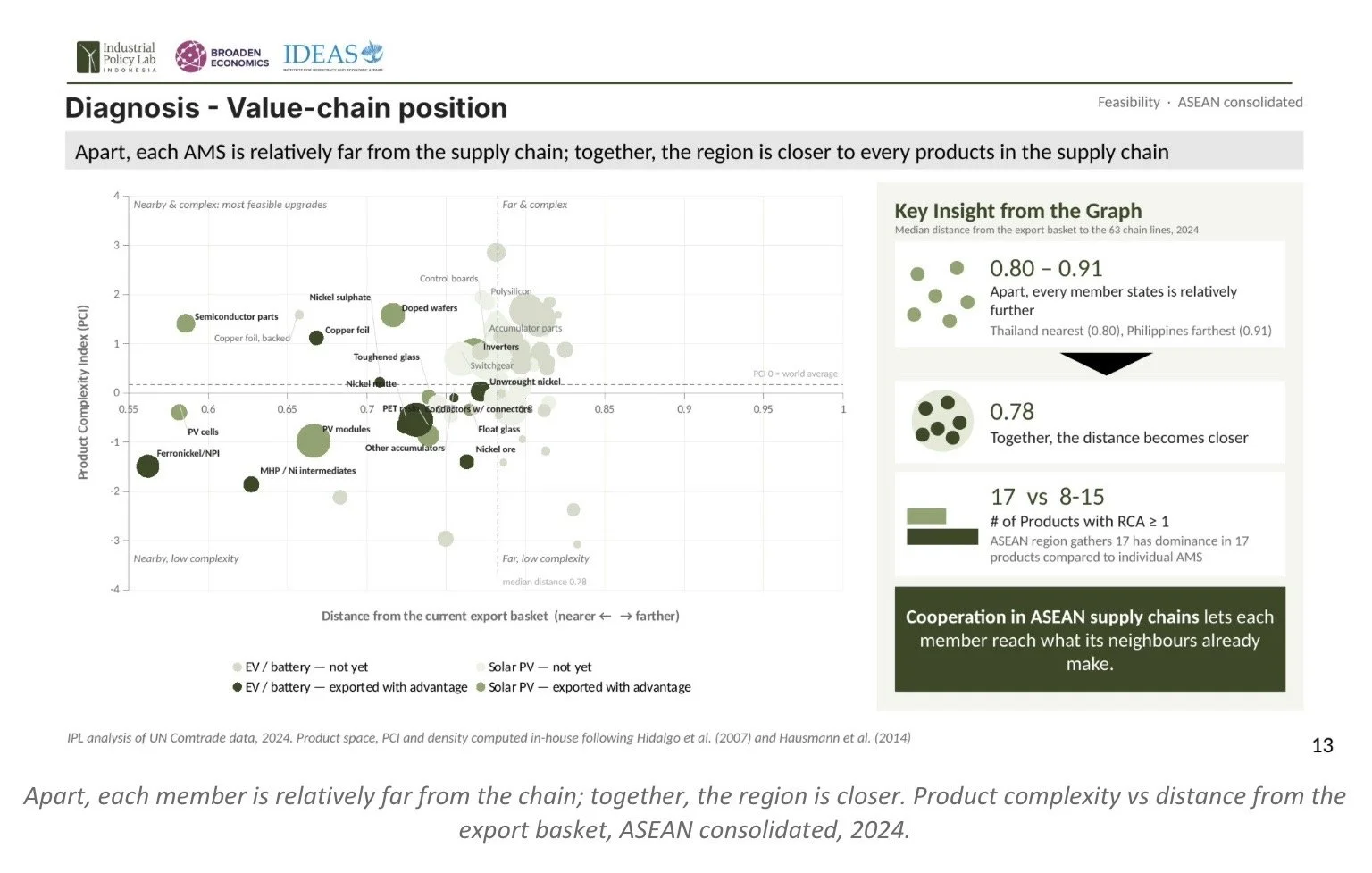
We also measured how close each member is to the products in these chains, based on what it already exports. On their own, members are relatively far: Thailand is nearest, the Philippines farthest. Taken together as one region, ASEAN is closer to every product in the chain, and holds an advantage in 17 of them, compared with 8 to 15 for any single member. In other words, members can reach more of the chain through what their neighbours already make.
2. What each government is doing
We mapped the policy instruments used in these two chains by Indonesia, Malaysia, Singapore, Thailand and Vietnam. Each is building a different piece, largely without reference to its neighbours. Indonesia uses its nickel to pull smelting and battery investment onshore and protects its solar market through local content (TKDN) rules, but support for the middle of the chain, such as battery cells and solar wafers, is thin. Malaysia's support concentrates on EV market access and solar deployment. Thailand is turning EV demand into local assembly and batteries, while stepping back from solar manufacturing. Vietnam focuses on EV assembly and solar deployment, and Singapore plays the role of importer, financier and standard-setter.
3. What the ASEAN framework offers
At the regional level, solar PV appears on ASEAN's investment promotion agenda, but EVs and batteries do not. The ASEAN Comprehensive Investment Agreement (ACIA) restricts new local content requirements, while incentives remain fully national with no regional coordination. The closest existing tool, the ASEAN Industrial Projects Based Initiative (AIPBI), can harmonise incentives project by project, but we found no public record of an approved AIPBI project so far, and responsibility for these chains is spread across several ASEAN bodies.
Key takeaways from the discussion
• Developing economies start the industrial policy race behind. Less fiscal space and tighter trade rules mean ASEAN members cannot simply match the subsidies of advanced economies, which makes regional coordination more valuable.
• The empty stages are an opportunity. Because no member yet holds battery cells, cathode materials or finished vehicles, a regional division of labour in these segments can still be designed rather than inherited.
• ASEAN is stronger together than apart. The region as a whole sits closer to the supply chain than any single member, which is the core economic case for coordination.
• National strategies are not talking to each other. Each member supports a different part of the chain, and some rules, such as local content scoring that gives no credit to inputs from ASEAN neighbours, work against regional supply chains.
• Coordination may mean transparency rather than removing rules. Local content and export rules are legitimate tools, and investors often care more about predictability than strictness. One idea raised was for ASEAN to make national requirements visible and predictable, through a regional register, advance notice before rules change, and a forum where members explain their policies.
• Open questions remain. Would member states accept anchoring one segment rather than chasing the whole chain? What is in it for members that are already well advanced? And how can trade rules leave more room for latecomers' industrial policy?
What comes next
The next stage of the study is a benchmarking phase. We will look closely at how other regions coordinate green industrial policy, including the European Union's state aid rules and its Important Projects of Common European Interest, Africa's continental minerals and green industrialisation initiatives, and supply-chain coordination in South America, such as the lithium and copper declaration among Chile, Argentina, Bolivia and Peru and the Argentina–Brazil automotive agreement. The aim is to draw out what could work in an ASEAN setting, and what would not.
Alongside this, we will refine the supply-chain and policy analysis based on feedback from the roundtable, and continue conversations with partners who have reached out to us since the event.
We would like to thank everyone who joined us in Bangkok and online for their questions and input. If you work on these issues and would like to contribute to the next phase, we would be glad to hear from you.